AI Adoption Map in the ASEAN Region in 2025
INFOGRAPHICS
2/6/2026
Artificial intelligence (AI) adoption is the application of AI technology in various activities to increase productivity and drive innovation. In the governmental sphere, a country is said to have adopted AI when this technology is used in at least one government function, such as public services, data management, or administrative processes. Its application also varies, ranging from simple automation to advanced AI usage, including generative AI applications.
The “AI Boom” phenomenon has been strongly felt since the early 2020s, especially after the launch of ChatGPT by OpenAI. To date, AI is not just an ordinary technological tool but continues to evolve as a means to solve problems, improve operational efficiency, and support decision-making. Along with this rapid development, AI adoption has now spread to various sectors, ranging from industry, government, finance, and health to education.
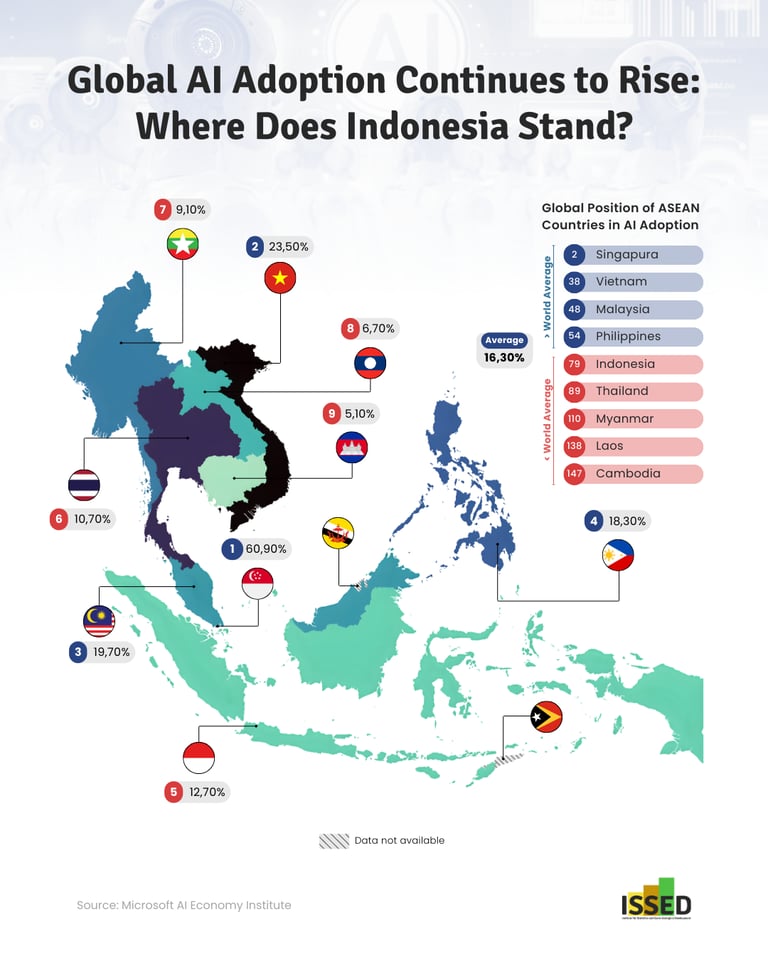
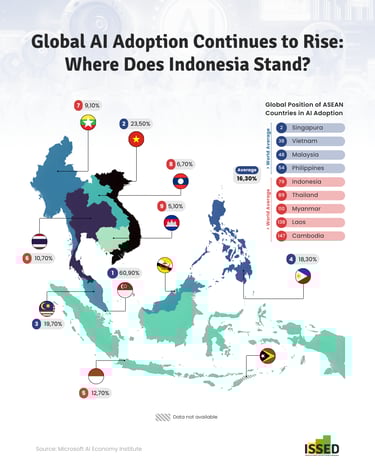
So, to what extent has AI adoption taken place in ASEAN countries? The Global AI Adoption 2025 report notes that Singapore—as the most advanced country in the region—has adopted AI in nearly 60.90% of its state activities. This figure is not only the highest in ASEAN but also the second-highest AI adoption in the world.
Meanwhile, ASEAN countries in the middle group are still quite far behind Singapore. Vietnam recorded around 21.10%, followed by Malaysia (19.70%), the Philippines (18.20%), Indonesia (12.70%), and Thailand (10.70%). Below them are Myanmar (9.10%), Laos (6.70%), and Cambodia (5.10%). However, all of these countries show an upward trend in AI adoption from year to year, albeit at different rates.
AI adoption has the potential to drive a country's progress, but its implementation is not always easy. The main challenges often come from limited human resources, funding, and infrastructure readiness. Singapore, for example, is able to allocate large funds for technology development because its basic needs are relatively well met, coupled with the availability of adequate talent and expertise. Conversely, countries with more limited economic capacity, such as Laos and Myanmar, still face major obstacles, both in terms of funding and knowledge gaps, which have prevented the rapid development of AI adoption.